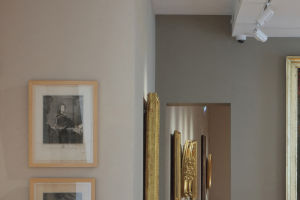
An artwork communicates through more than its subject. The arrangement of visual elements determines how the eye moves, what receives emphasis, and how the work feels as a whole.
Composition, color, line, shape, form, texture, and space each contribute to this visual structure. Understanding their relationships can make looking at art more focused and rewarding.
Read the Composition
Begin with the overall arrangement rather than a single detail. Notice the focal point, the distribution of visual weight, and the relationship between major and minor elements.
Artists can establish order through symmetry, repetition, proportion, alignment, and spacing. They can also create energy through asymmetry, contrast, diagonal arrangements, or variations in scale. Examining these relationships reveals how the composition controls attention.
Analyze Color
Color can establish emphasis, atmosphere, and unity. Consider the dominant palette and identify areas where contrasting or complementary colors attract attention.
Also observe repetition. A color appearing in several parts of an artwork can connect otherwise separate elements, while a small area of a distinctive hue can become a visual accent. Looking at color as a system rather than as isolated shades reveals its role in organizing the composition.
Trace Visual Direction
Line provides pathways through an artwork. Horizontal lines can contribute to stability, vertical lines can suggest height, and diagonals can introduce a stronger sense of movement. Curved lines may create continuity between different areas.
Look for directions created by edges, gestures, contours, or the arrangement of objects. These visual pathways can lead the eye toward a focal point or establish connections across the composition.
Examine Shape and Form
Shape defines the boundaries of elements in two-dimensional artwork. Geometric shapes often provide structure and precision, while organic shapes can introduce greater fluidity.
Form becomes particularly important in three-dimensional work, where volume, depth, surfaces, and physical presence affect the viewing experience. Consider how solid forms interact with surrounding space and how changes in viewpoint reveal different relationships.
Study Texture and Material
Texture describes the character of a surface, whether smooth, rough, layered, polished, or visibly marked. These qualities can add visual variety and influence how an artwork is perceived.
Material is equally important. Paint, wood, metal, fabric, paper, clay, and mixed materials each offer different possibilities for surface and structure. Examining material choices can provide insight into how the physical construction supports the artwork's visual character.
Evaluate Space
Space is an active part of composition. Areas surrounding or separating forms can emphasize important elements, establish distance, and create visual breathing room.
Compare open areas with concentrated sections of the artwork. Consider how spacing affects scale, rhythm, hierarchy, and balance. A composition can feel organized without being symmetrical when its elements are distributed with intention.
Observe Before Interpreting
Before reading accompanying information, spend time describing what is visibly present. Identify the colors, shapes, proportions, materials, textures, and spatial relationships without immediately assigning meaning.
Afterward, contextual information can provide another layer of understanding. Returning to the artwork with this additional perspective can reveal connections that were not obvious during the first viewing.
Record Significant Details
Brief observations can sharpen visual attention. Note what initially attracts your eye, what becomes noticeable after longer examination, and which element appears most important to the overall structure.
A simple sketch can also be useful for studying proportion, repetition, or arrangement. It does not need to be detailed; its purpose is to translate observation into a more deliberate process.
Identify Artistic Style
Style develops through patterns of artistic decisions. Rather than relying only on an artwork's overall appearance, examine recurring approaches to color, composition, line, form, materials, and mark-making.
An artist may consistently favor geometric structures, restrained palettes, expressive marks, organic forms, or pronounced contrasts. Recognizing these recurring characteristics can help explain what gives a body of work its visual identity.
Connect Design and Meaning
Visual choices influence interpretation. Scale can alter the perceived importance of an element, contrast can establish emphasis, and composition can determine relationships between forms. Material and texture can further affect the character of the work.
Interpretation becomes stronger when it is grounded in visible evidence. Instead of separating meaning from design, consider how the artwork's formal decisions contribute to what it communicates.
Look at the Artwork as a Whole
After examining individual elements, return to the complete composition. Consider how color, direction, shape, form, texture, and space function together rather than independently.
This final step brings the analysis together. An artwork's impact often comes from the interaction of its components, with each decision supporting the larger visual structure.
Visual design gives an artwork its structure, rhythm, emphasis, and character. By examining composition, color, line, shape, form, texture, material, and space, viewers can understand how individual decisions combine to create a coherent visual experience. Careful observation does not require specialized knowledge; it begins with noticing relationships, asking thoughtful questions, and allowing the artwork's design to guide deeper understanding.