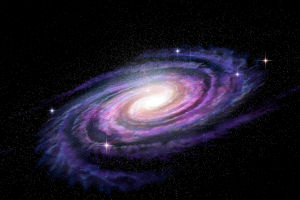
At first glance, the night sky appears calm and unchanging. Yet at the very core of our galaxy lies a region of extreme gravity, violent motion, and intense radiation. The center of the Milky Way is not simply a dense cluster of stars—it is a dynamic environment shaped by one of the most mysterious objects in modern astrophysics.
Hidden behind vast clouds of gas and dust, this region has challenged astronomers for decades, forcing them to rely on indirect observation and cutting-edge technology to uncover its secrets.
The Discovery of a Hidden Giant
For much of the 20th century, scientists suspected that something massive resided at the galactic center, but direct evidence remained elusive. Visible light cannot pass through the dense interstellar material that blocks our line of sight. It wasn’t until the use of infrared and radio astronomy that researchers began to map stellar movements near the core.
What they found was astonishing: stars orbiting an invisible object at extraordinary speeds, tracing tight elliptical paths. The only explanation that matched these observations was a supermassive black hole, now known as Sagittarius A*. This object contains a mass equivalent to about four million suns, compressed into a region smaller than our solar system.
The work of scientists such as Andrea Ghez and Reinhard Genzel, who tracked stellar orbits with remarkable precision, provided definitive proof of its existence—research that later earned them the Nobel Prize in Physics.
A Black Hole That Doesn’t Behave as Expected
Despite its enormous mass, Sagittarius A* is surprisingly quiet compared to black holes in other galaxies. Many galactic centers emit powerful jets and radiation as matter spirals inward, creating what astronomers call active galactic nuclei. In contrast, our galaxy’s core is relatively subdued.
This doesn’t mean it is inactive. Occasional flares of X-rays and infrared light suggest that material is still being consumed, albeit at a slower rate. Some researchers believe this calm state may not be permanent. Evidence indicates that Sagittarius A* was far more active in the past, possibly producing energetic outflows that shaped surrounding regions. Understanding why this black hole is less luminous than others of similar size remains an open question. It challenges existing models of how these objects grow and interact with their environments.
The Extreme Environment Around the Core
The region surrounding Sagittarius A* is unlike any other place in the galaxy. Stars here are packed tightly, moving at velocities that would be unimaginable elsewhere. Some complete an orbit in just a few years, compared to the Sun’s 230-million-year journey around the galaxy.
In addition to stars, the area contains hot gas clouds, magnetic fields, and remnants of past stellar explosions. One particularly intriguing feature is the presence of “S-stars,” a group of young, massive stars orbiting dangerously close to the black hole. Their existence raises questions about how such stars could form in such a hostile environment.
Seeing the Unseeable
Capturing an image of something that does not emit light might seem impossible, yet in 2022, scientists achieved exactly that. Using a global network of radio telescopes known as the Event Horizon Telescope, researchers produced the first image of Sagittarius A*. The image revealed a glowing ring of hot material surrounding a dark central shadow—the silhouette of the black hole itself.
This breakthrough required synchronizing observatories across multiple continents, effectively creating a telescope the size of Earth. The result not only confirmed theoretical predictions but also provided new insights into how matter behaves under extreme gravitational forces.
Mysteries That Remain Unsolved
Despite these advances, many questions persist. How did Sagittarius A* form in the early universe? Why is it currently so quiet? What role does it play in regulating star formation across the galaxy? These are not trivial puzzles—they are central to understanding how galaxies evolve.
There is also growing interest in the possibility of intermediate-mass black holes orbiting near the center, as well as the influence of dark matter in shaping the region’s dynamics. Each new observation adds another piece to a complex and still incomplete picture.
Studying the center of the Milky Way is more than an exercise in curiosity. It offers a unique laboratory for testing the laws of physics under conditions that cannot be replicated on Earth. The interplay between gravity, energy, and matter in this region provides clues about the fundamental workings of the universe.